
Soft tissue augmentation: Material meets technique

Soft tissue augmentation has become an integral component of contemporary implant therapy. Beyond esthetic considerations, the thickness and quality of peri-implant soft tissues are increasingly recognized as critical determinants of long-term stability and peri-implant health. Consequently, augmentation procedures are now routinely performed not only in the anterior region but also in posterior sites where tissue resilience is essential.
Autogenous subepithelial connective tissue grafts (CTG) remain the reference standard for increasing soft tissue thickness. However, their clinical application is associated with well-documented limitations, including donor-site morbidity, increased surgical time and variability in tissue availability. These limitations have driven the development of soft tissue substitutes, particularly volume-stable collagen matrices, designed to reduce patient burden while maintaining clinical effectiveness.
The present article summarizes and contextualizes findings from a controlled cadaveric study investigating how graft material, graft thickness, and flap design influence flap tension and initial soft tissue volume gain1. Rather than focusing on clinical superiority, the objective is to provide a mechanistic understanding of factors influencing wound closure in soft tissue augmentation procedures.
Why Soft Tissue Thickness and Flap Tension Matter
The importance of peri-implant soft tissue thickness has been increasingly emphasized over the last decade. Thicker soft tissues appear to provide a more stable peri-implant environment, both biologically and mechanically.
From a biological perspective, thicker tissues may:
- Improve vascular supply and wound healing
- Enhance resistance to mechanical and inflammatory challenges
- Contribute to more stable mucosal margins over time
Systematic evidence suggests that thin peri-implant tissues are more prone to recession and esthetic compromise, whereas thicker tissues are associated with more favorable outcomes.
However, achieving increased volume is only one part of the equation. The surgical pathway to reach this goal, particularly the ability to achieve tension-free wound closure, remains a critical, yet often underestimated factor.
Successful soft tissue augmentation requires not only volume gain but also stable, passive wound closure. Excessive flap tension at the time of closure may compromise vascularization, increase the risk of early complications, and potentially affect long-term outcomes.
Despite its clinical relevance, flap tension is rarely quantified and is typically assessed subjectively. Clinicians are familiar with the challenge: as graft thickness increases, flap mobility decreases, and closure becomes more demanding.
This interplay between graft dimension, material properties, and flap design formed the basis of our experimental investigation.
"It was not really a clinical problem, but it was something that we observed clinically. And we saw that actually the flap when we close it somehow has a memory, not by the flap but by the substitute that is inserted. So it slowly sucks up the blood from around. And we realize that maybe the flap design we were classicly using was not the best one. However, we had to confirm that somehow."
Study Rationale and Design
To isolate mechanical factors under controlled conditions, a cadaveric model using fresh porcine jaws was employed. This allowed standardized comparison of different variables at identical sites.
The study evaluated:
| Graft materials* | Graft thicknesses | Flap designs |
|---|---|---|
| Subepithelial connective tissue graft (CTG) | 3 mm | Split-thickness flap |
| Volume-stable collagen matrix (Geistlich Fibro-Gide®) | 6 mm | Palatal island flap |
* Each graft material was evaluated at both thicknesses and with
both flap designs, resulting in eight experimental combinations.
Flap tension was measured quantitatively, and volumetric changes were assessed using digital intraoral scanning and three-dimensional profilometric analysis.
Importantly, the study focused exclusively on mechanical behavior and initial volume gain, without evaluating biological healing.
Initial Volume Gain: When Biology Meets Mechanics
At a graft thickness of 3 mm, both CTG and the collagen matrix demonstrated comparable initial volume gain. This finding suggests that, under favorable mechanical conditions, both materials are capable of achieving clinically relevant augmentation.
At 6 mm thickness, greater volume gain was observed, particularly with the collagen matrix. However, this was critically dependent on flap design. Notably, closure could not be achieved with a 6 mm CTG when using a conventional split-thickness flap.
These findings highlight an important concept:
The achievable volume is not only determined by the graft itself, but also by the mechanical environment in which it is placed.
The Influence of Flap Design
Flap design emerged as a decisive factor influencing both flap tension and volume gain.
The palatal island flap consistently demonstrated:
- Lower flap tension
- Greater overall and crestal volume gain
- Reliable wound closure across all groups
In contrast, the split-thickness flap showed higher tension values and clear limitations in thicker augmentations. Across all conditions, the palatal island flap resulted in significantly greater volumetric outcomes.
From a clinical perspective, this reinforces that flap design is not a secondary consideration, it is a central component of treatment planning, particularly when aiming for substantial volume increase.
“I agree, it's very spectacular when you actually see how clinically relevant is the expansion of the material. However, it's not a limitation of it. It's just something we have to take into consideration. And once again, it shows the importance to understand the substitutes we are actually using. So it's basically understanding the material and then adapting to the material, rather than sticking to the pathways that we knew from the other materials that we used before.”
Flap Tension and Material Behavior
Differences in flap tension between materials were consistently observed. The volume-stable collagen matrix demonstrated lower tension values compared with CTG. The study authors suggest that this may be related to differences in the mechanical properties of the two materials: while autogenous connective tissue has limited compressibility, Geistlich Fibro-Gide® has a porous, sponge-like structure that allows the matrix to be compressed.
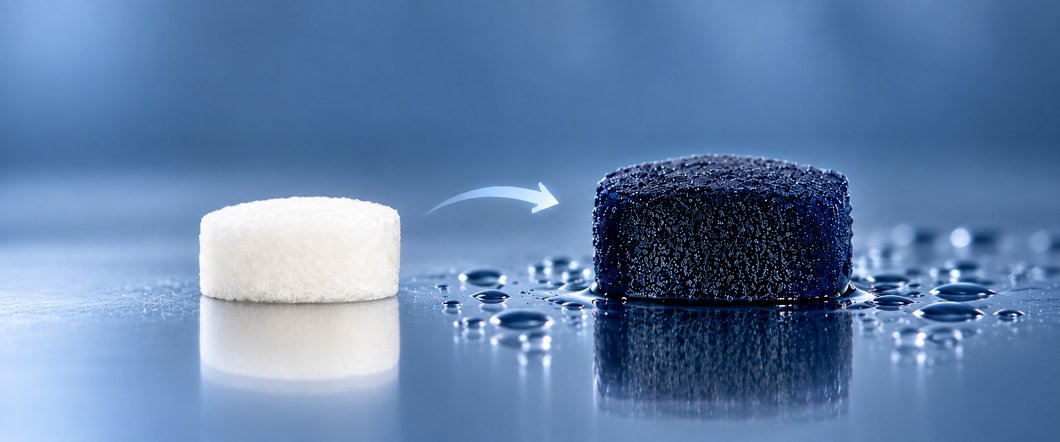
The behavior of Geistlich Fibro-Gide® changes as the matrix absorbs liquid. In this visual demonstration, the hydrated matrix visibly expands compared with the dry sample. This expansion is an important material characteristic to consider when selecting graft dimensions and planning flap design and wound closure.
This observation also reflects a clinical experience that motivated the study: after placement, the authors observed that the substitute absorbs surrounding fluid and changes in volume, raising the question of whether conventional flap designs provide sufficient space for the material.
“When deciding on the flap design, we first have to elaborate and understand the defect that we are dealing with because that will define what is our flap design. The second is also then the material we are using. So when we are using a material that tends to expand or somehow suck up the blood from around, then we have to approach it differently and understand how the healing phase will look like. So we don't decide primarily only by the substitute, but rather also by the defect that we are correcting with our surgery.”
The second demonstration shows another aspect of the matrix's mechanical behavior: after being compressed, Geistlich Fibro-Gide® rebounds toward its original shape. This compressibility may help explain why lower flap tension values were observed with the collagen matrix compared with CTG in the study.
However, the ability to compress the material should not be interpreted as a reason to close the flap under tension. Preclinical evidence cited by the authors suggests that compression of volume-stable collagen matrices may slow cellular ingrowth. The goal therefore remains to minimize tension during wound closure, particularly when using substitute materials.
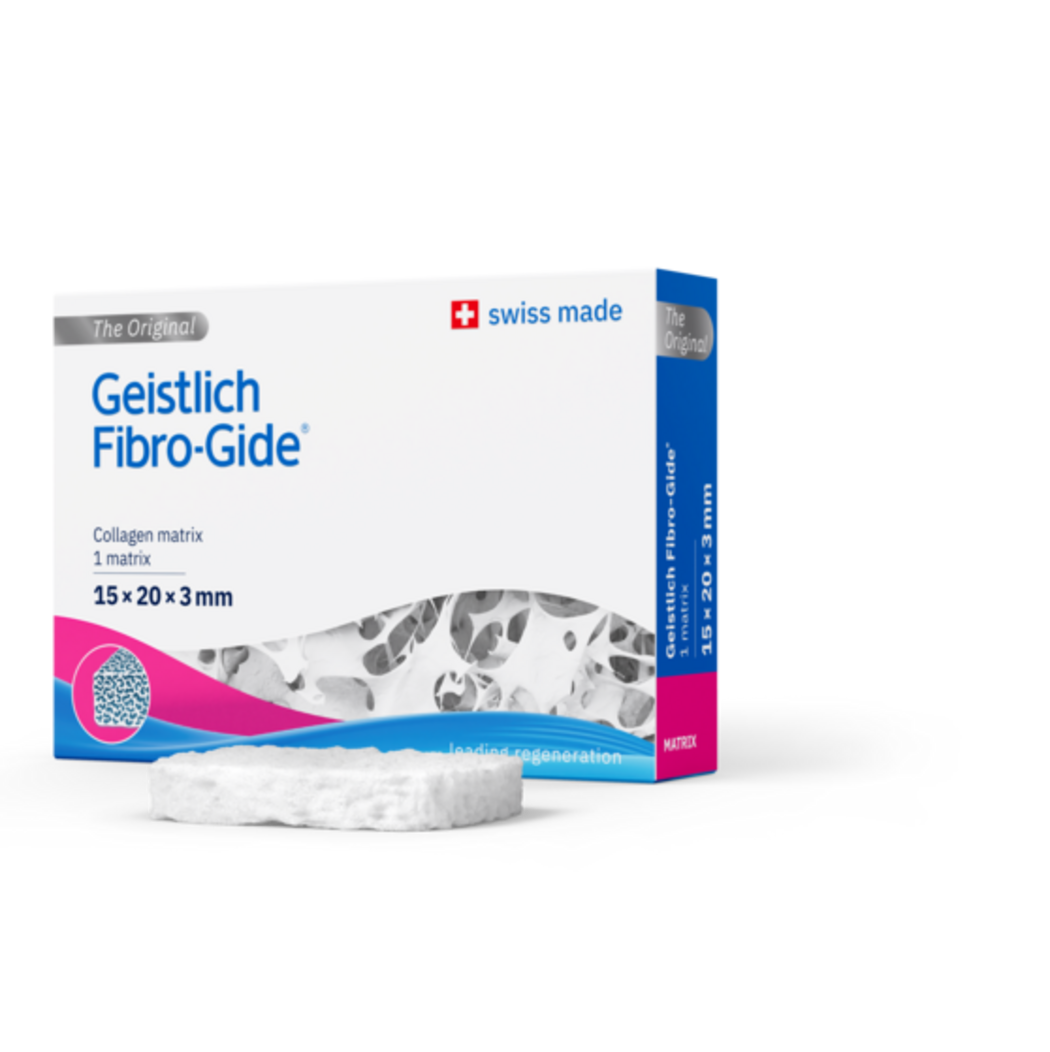
Discover Geistlich Fibro-Gide®
Learn more about the volume-stable collagen matrix designed for soft tissue regeneration as an alternative to autogenous connective tissue grafting in appropriate indications.
CTG or Collagen Matrix: How Do You Decide?
Connective tissue grafts remain the reference standard for soft tissue augmentation. At the same time, autogenous tissue harvesting is limited by patient anatomy and associated with additional morbidity.
This raises an important clinical question: when can a collagen matrix be considered as an alternative, and when is CTG still preferred?
“So, when to use collagen matrices as opposed to a gold standard, which is connective tissue graft, and it still remains a gold standard? Well, the reason why we even came up with the substitutes, or the industry came up with these substitutes, is that we are limited by the anatomy for the patients, and also morbidity is much higher. So, of course, if you get to choose, what would you do for yourself? I tend to believe that we would all prefer to go into the direction of a substitute. However, it has some limitations, and we cannot use it for everything. So, when we expect that the substitute will be exposed, then we rather opt for a connective tissue graft. This is one thing, and the other things are depending on the defect that we are dealing with. So, first we have to decide what type of a defect it is, and then what are the options that we have. And based on that, calculate every single detail, putting it together, that makes it understand how we're going to approach the case.”
In clinical practice, this should not be considered a binary choice. Defect characteristics and the anticipated clinical situation remain central to material selection. Importantly, where exposure of the graft is expected, CTG may remain the preferred option.
What Do These Findings Mean for Clinical Practice?
Combining biological evidence with mechanical insights allows for a more comprehensive clinical perspective:
Moderate augmentation
At a graft thickness of 3 mm, both CTG and the collagen matrix demonstrated comparable initial volume gain.
Larger augmentation
Flap design becomes increasingly important. Adequate tissue release, such as with a palatal island flap, may be essential to enable closure.
Material behavior
The compressibility and elastic recovery of Geistlich Fibro-Gide® need to be considered when planning flap design and wound closure.
Treatment planning
Material selection, graft dimension, defect characteristics and flap design should be considered as an integrated concept rather than independent variables.
How Should These Findings Be Interpreted?
As with any experimental study, our findings have limitations. This was a cadaveric model, and no conclusions can be drawn regarding vascularization, integration, remodeling or long-term soft tissue stability.
The results should therefore not be interpreted as evidence of clinical superiority of one graft material over another. Instead, they provide insight into mechanical interactions at the time of surgery, which represent an important but often underappreciated aspect of soft tissue augmentation.
Because collagen-based soft tissue substitutes differ substantially in composition, cross-linking and structural stability, the mechanical behavior observed in this study applies specifically to the volume-stable collagen matrix evaluated (Geistlich Fibro-Gide®) and should not be generalized to all collagen matrices.
Previous preclinical research has suggested that excessive compression of collagen matrices may negatively influence cellular ingrowth. From this perspective, our findings further highlight the importance of tension-minimizing flap designs, particularly when using substitute materials.
Clinical studies with longer follow-up remain essential to determine how these mechanical differences translate into long-term outcomes.
“One of the things that still remains unanswered is how much impact this expansion actually has on the healing phase and how much on the end results. So, of course, with that, we also need a little bit more material and results on the long-term results and how it actually is over the years.”
One of the key questions that remains is therefore how the expansion observed mechanically affects the healing phase and, ultimately, long-term clinical outcomes.
Conclusion
Soft tissue augmentation is not determined by material choice alone. This study highlights how graft material, graft thickness and flap design interact mechanically and influence both flap tension and initial volume gain.
Within the limitations of the experimental model, Geistlich Fibro-Gide® demonstrated comparable initial volume gain to CTG at 3 mm thickness and lower flap tension during closure.
Ultimately, successful soft tissue augmentation requires an integrated approach: understanding the defect, selecting an appropriate material and graft dimension, and adapting the flap design to the clinical situation and the behavior of the chosen material.
Explore Palate-Free Soft Tissue Augmentation
Discover clinical cases, techniques and educational resources on soft tissue augmentation with Geistlich Fibro-Gide®.

Reference
1. Pirc M et al.: J Periodontal Implant Sci. 2025 Aug;55(4):285-294. (preclinical study)

Dr. Miha Pirc
Senior Clinician Teaching and Research Assistant, Clinic of Reconstructive Dentistry, University of Zurich
MClin Prosthodontics, MAS Implantology, MClin Periodontology