Why predictable Ridge Preservation starts with biology
Key Takeaways
- Predictable regeneration begins with understanding biology, not simply filling a socket
- Atraumatic extraction and clot stability play a critical role in preserving future treatment options
- Material selection should support both healing dynamics and long-term tissue stability
- Ridge preservation is not about perfection, it is about creating predictable foundations for future care
- Young clinicians can build confidence in regeneration by focusing on biological principles rather than shortcuts
Regeneration is more than a procedure
In today’s dental landscape, clinicians are exposed to countless products promising faster workflows, easier handling, or “equivalent” results at lower cost. At the same time, social media often rewards speed, perfect before-and-after images, and increasingly aggressive treatment approaches.
But regenerative dentistry is different.

Unlike many restorative procedures, regeneration is not judged on the day of surgery. Its success becomes visible months, or even years later, when tissue stability, esthetics, and implant success are truly tested.
That is why experienced clinicians consistently return to one principle:
Predictable regeneration starts with respecting biology.
This philosophy also underpins the interdisciplinary clinical and educational approach at The Campbell Clinic and The Campbell Academy, where long-term tissue stability, biological understanding, and preservation of future treatment options remain central treatment objectives.
In this clinical case, I will demonstrate my step-by-step alveolar ridge preservation approach following traumatic tooth loss in a young patient. More importantly, I want to explain the biological reasoning behind every treatment decision.
The case: preserving future options after trauma
The patient, a 26-year-old primary school teacher, presented after a hockey accident involving fracture and luxation injuries affecting the maxillary anterior teeth. The initial periapical X-ray revealed a clear fracture of tooth #21 and lateral luxation of teeth #11 and #12. Further CBCT evaluation confirmed a radicular fracture of tooth #21.
Following multidisciplinary evaluation, tooth #21 was deemed non-restorable and scheduled for extraction with implant placement planned in a second stage after orthodontic treatment.
For many clinicians integrating regeneration more routinely into practice, this type of case highlights an important shift in treatment philosophy:
Ridge preservation is not only about replacing lost tissue.
It is about protecting future treatment possibilities.
In esthetic areas especially, preserving hard and soft tissue architecture can significantly influence:
- Future implant positioning
- Soft tissue stability
- Papilla preservation
- Esthetic outcomes
- Treatment complexity later on
This long-term perspective is one of the reasons why biologically driven regeneration has become increasingly important in modern implant dentistry.
Choosing Materials for Long-Term Stability
Before starting the surgical procedure, I always think carefully about instrument and biomaterial selection. For me, these decisions are not based on convenience alone, but on how different materials support healing dynamics and long-term tissue stability.
In this particular case, I selected a xenograft approach using Geistlich Bio-Oss® Collagen because I anticipated an extended healing period associated with the patient’s orthodontic treatment. In situations like this, I look for a material that provides both turnover and long-term stability while supporting predictable healing over time.
I also chose Geistlich Mucograft® Seal instead of a traditional collagen membrane because, it maintains its integrity, as well as promote keratinized tissue formation more predictably in an exposed healing environment.
In my experience, biological reasoning is essential for achieving predictable regenerative outcomes. Regenerative materials should not simply be selected based on price or handling characteristics alone, but on how predictably they support tissue healing and long-term tissue stability.
Step 1: Atraumatic tooth extraction protects biology
The procedure begins with careful severing of supracrestal fibers using a 15C blade before extraction. Thin luxators and straight forceps with long, thin beaks are then used to minimize trauma to surrounding tissues and preserve soft tissue integrity.
This first step already reflects a key principle of predictable regeneration:
The biology you preserve during extraction directly influences healing potential.
Aggressive extraction techniques may compromise:
- Buccal bone integrity
- Soft tissue architecture
- Blood supply
- Wound stability
By contrast, atraumatic extraction aims to preserve the biological environment needed for regeneration to occur predictably.
For clinicians early in their regenerative journey, this is often an important mindset shift:
excellent regenerative outcomes often begin with restraint, precision, and tissue preservation, not aggressive intervention.
Step 2: 360° socket debridement
Following extraction, the socket is carefully inspected and debrided to remove debris and evaluate socket integrity. In trauma cases particularly, assessment of potential dehiscence defects or alveolar fragments is essential before grafting.
This stage may appear simple, but it reflects another hallmark of experienced regenerative clinicians:
Predictability depends on understanding the defect, not simply treating it.
Successful regeneration is rarely “plug and play.” Biological conditions differ from case to case, and careful assessment remains essential for long-term stability.
Step 3: Socket grafting and blood clot stabilization
For socket grafting, I selected Geistlich Bio-Oss® Collagen because it offers a good balance between remodeling and long-term volume stability.
When grafting extraction sockets, one principle strongly guides my approach:
I do not want a socket full of biomaterial, I want a socket full of blood,
stabilized and supported by a stable scaffold such as Geistlich Bio-Oss® Collagen.
For me, this is a critical concept in regenerative dentistry. The graft material does not replace biology. Instead, it supports and stabilizes the body’s natural healing process.
I intentionally place Geistlich Bio-Oss® Collagen dry, allowing it to gradually integrate with the patient’s blood clot while carefully avoiding compression of the graft.
One of the reasons I appreciate the structure of Geistlich Bio-Oss® Collagen is that it helps stabilize the blood clot while preventing particle migration and the so-called “popcorn effect.”
In my experience, successful regeneration is not about forcing healing. It is about creating the right conditions for healing to occur predictably over time.
Step 4: Socket sealing and soft tissue stability
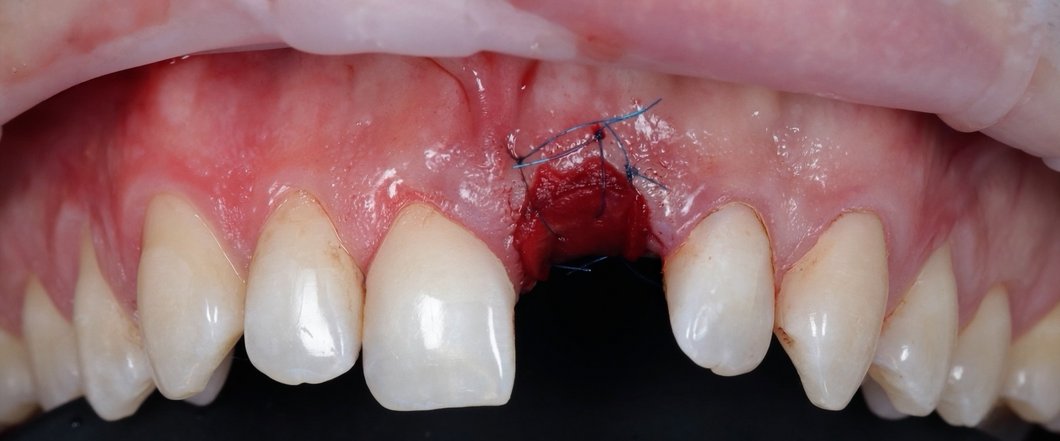
To protect the grafted site, Geistlich Mucograft® Seal was used for socket sealing in an open-healing environment. I selected the 8 mm version for this anterior site and stabilized it using non-absorbable 6.0 sutures.
Soft tissue management remains one of the most underestimated factors in regenerative success. Stable soft tissue not only supports wound protection but also contributes to long-term esthetic integration and patient comfort.
I prefer Geistlich Mucograft® Seal over a conventional collagen membrane in this case because it maintains integrity more effectively in an exposed healing environment.
Understanding soft tissue biology early can dramatically improve confidence in regenerative procedures.
Because in many cases:
Long-term stability depends less on surgical “heroics” and
more on respecting tissue behavior during healing.
Step 5: Temporarisation and interdisciplinary planning
Following socket sealing, I proceed with temporarisation using a temporary denture while coordinating the patient’s transition into orthodontic treatment. Aligners were planned only a few weeks later as part of the interdisciplinary workflow.
Although often overlooked in surgical education, temporarisation plays an important role in:
- Patient comfort
- Esthetic management
- Tissue protection
- Treatment acceptance
- Continuity
For clinicians building confidence in regeneration, this highlights an important aspect of modern regenerative dentistry:
Successful treatment is rarely a single procedure, it
is a coordinated biological and restorative journey.
This type of long-term thinking helps clinicians move beyond “tooth replacement” toward comprehensive patient-centered care.
Step 6: Healing Outcome and Implant Placement
Following orthodontic treatment, implant placement was performed after nine months of healing. At re-entry, the site demonstrated stable soft tissue contours, preserved papillae, and excellent bone volume without the need for additional grafting.
CBCT evaluation also revealed favorable bone density within the healed area, supporting implant placement in a prosthetically driven position.
In a profession increasingly focused on speed and efficiency, this case offers an important reminder:
Fast treatment is not always the same as predictable treatment.
Biological regeneration follows its own timeline. Clinicians who understand and respect these healing dynamics are often better positioned to achieve stable long-term outcomes.
Posterior Ridge Preservation
While anterior cases often emphasize esthetic outcomes and soft tissue preservation, the same biological principles remain equally important in posterior regions.
Molar extraction sites can present additional challenges due to:
- Multi-root anatomy
- Larger socket dimensions
- Increased risk of ridge collapse and proximity to the air sinus
- More complex extraction procedures
For this reason, atraumatic extraction and stable clot protection remain essential for preserving ridge volume prior to implant placement.
To conclude the workflow, this posterior molar case highlights how biologically driven treatment principles can support predictable clinical outcomes through:
- Careful tooth separation
- Atraumatic root removal
- Socket grafting
- Soft tissue sealing
- Preservation of future implant treatment options
Importantly, this reinforces a key message throughout the article:
Respecting biology is not limited to complex esthetic cases.
It is a treatment philosophy that can support more predictable healing and long-term stability across everyday clinical practice.
Why long-term thinking matters for younger clinicians
Many early-career clinicians understandably focus on:
- Improving efficiency
- Mastering workflows
- Building surgical confidence
- Integrating new technologies
But long-term professional confidence is built differently.
It is built through:
- Predictable healing
- Trust in biological principles
- Understanding complications
- Consistent outcomes over time
- Choosing materials and techniques clinicians can still stand behind years later
This is one reason why long-term evidence remains highly relevant in regenerative dentistry.
One of the reasons I continue using Geistlich Bio-Oss® in my daily practice is the long-term evidence behind it. When we are making regenerative decisions, especially in younger patients, we are making decisions that should remain stable for many years.
For clinicians building confidence in regeneration, this type of evidence provides more than scientific reassurance. It provides confidence.
Regeneration done thoughtfully
Clinicians do not need to become “superstar surgeons” overnight to practice successful regenerative dentistry.
What matters most is developing:
- Biological understanding
- Careful treatment planning
- Respect for tissue behavior
- Patience during healing
- Commitment to long-term outcomes
In my experience, predictable regeneration is often less about complexity, and more about making biologically sound decisions consistently.
Because ultimately:
The goal of regeneration is not simply to place an implant.
It is to create stable foundations patients can rely on for years to come.
References
- Barootchi S, et al.: Periodontol 2000. 2023 Jun;92(1):235-262. (review article)
- Eeckhout C, et al.: J Clin Med. 2024 Apr 16;13(8):2293. (clinical study)
- Jung RE, et al.: J Clin Periodontol. 2013 Jan;40(1):90-8. (clinical study)
- Jung RE, et al.: Periodontol 2000. 2018 Jun;77(1):165-175. (clinical study)
- Roccuzzo M, et al.: Int J Periodontics Restorative Dent. 2014 Nov-Dec;34(6):795-804. (clinical study)
- Tan WL, et al.: Clin Oral Implants Res. 2012 Feb;23 Suppl 5:1-21. (systematic review)
Dr. Beatriz Sanchez
Dental Surgeon at The Campbell Clinic,
Faculty Member of the The Campbell Academy
Dr. Colin Campbell
Specialist in Oral Surgery at The Campbell Clinic,
Director of The Campbell Academy
Related Articles