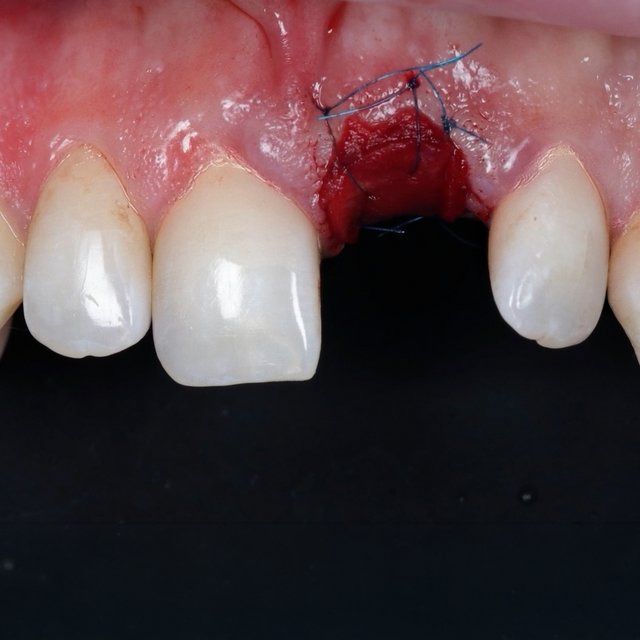
Ridge Preservation research: What the evidence shows

Key Findings
- Ridge preservation evidence confirms significant protection of ridge dimensions.1-3
- Xenogeneic bone substitutes combined with a resorbable membrane help stabilize extraction sites.2,4,5
- Guided Bone Regeneration (GBR) is still essential for larger defects, but early ridge preservation can reduce the need for complex augmentation.1-3
- Porcine collagen matrices can improve soft-tissue healing compared with autogenous grafts.1,5
- In the posterior maxilla, socket preservation reduces sinus pneumatization and can simplify dental implant placement.3
- Long-term clinical data show stable bone levels and favorable esthetic outcomes.1
Ridge Preservation: Why It Matters
After tooth extraction, bone remodeling begins immediately. Without intervention, up to 50% of ridge width can be lost within the first 6 months, complicating future dental implant planning. Ridge preservation, often referred to as socket preservation, has become a critical step in ensuring predictable outcomes for implant dentistry.1,2
Modern biomaterials, such as xenogeneic bone substitutes and barrier membranes have transformed how clinicians manage extraction sockets.1,2 The clinical studies reviewed here offer strong ridge preservation evidence that these techniques improve both functional and esthetic outcomes.1-5
Ridge Preservation Outperforms Spontaneous Healing
The literature repeatedly confirms that socket preservation minimizes bone loss. Systematic reviews show significantly reduced vertical and horizontal dimensional changes when compared to healing without grafts.6,7 Cardaropoli et al. 2012 demonstrated 1.08 mm more vertical bone height preservation after socket preservation (0.46 mm bone loss) compared with spontaneous healing (1.54 mm bone loss).2
These reductions may seem small numerically, but they dramatically influence subsequent surgical procedures, often eliminating the need for more invasive guided bone regeneration (GBR).2,3
Clinical evidence shows that alveolar ridge preservation results in significantly less contraction of the alveolar crest than spontaneous healing. The message is clear: doing nothing is the least predictable option.2,8
Xenogeneic Bone Substitutes in Ridge Preservation
Xenogeneic bone substitutes, particularly deproteinized bovine bone mineral (DBBM, e.g., Geistlich Bio-Oss®) and its collagen-enhanced form (DBBM-C, e.g., Geistlich Bio-Oss® Collagen), are among the most frequently studied materials in socket preservation procedures. These materials consistently showed characteristics that help stabilize extraction sites and support the healing process.1,5
Why DBBM is widely used
- Acts as a slowly resorbing scaffold2,4
- Maintains ridge contour2
- Supports new bone formation1,2,4
- Shows long-term stability1
Cardaropoli’s clinical and histological work demonstrated that DBBM particles become fully integrated with newly formed bone and maintain ridge width with minimal remodeling. No inflammation was observed around the particles, highlighting the material’s biocompatibility.2
Long-term stability
A 2024 clinical study1 with more than seven years of follow-up found:
- 100% dental implant survival
- Almost no marginal bone loss
- High Pink Esthetic Scores
after socket preservation using Geistlich Bio-Oss® Collagen and Geistlich Mucograft® Seal.
Together, these outcomes highlight the long-term stability of hard and soft tissues following ridge preservation with this protocol and provide evidence that it can help sustain predictable peri-implant conditions for many years.
Barrier Membranes and Collagen Matrices Improve Healing
A key component of effective socket preservation is the barrier membrane, used to protect the graft material and guide tissue regeneration.4
Native collagen membranes vs. cross-linked membranes
A multicenter RCT4 compared DBBM-C (Geistlich Bio-Oss® Collagen) + native bilayer collagen membrane (Geistlich Bio-Gide®) vs. allograft + cross-linked collagen membrane.
The group using DBBM-C and native collagen membranes showed:
- Significantly better ridge width preservation
- Better soft-tissue healing
- Fewer open incision lines
- No need for regrafting at implant placement
These findings indicate that native collagen membranes integrate faster, producing more favorable surgical outcomes.4
Porcine collagen matrices for open healing
Porcine collagen matrices (e.g., Geistlich Mucograft® Seal) offer a modern alternative to autogenous soft-tissue grafts. A clinical study by Fickl et al. shows5:
- Better color match
- Far less scarring
- No need for a second surgical site compared to palatal punch grafts
- Lower costs
Taken together, these results show that porcine collagen matrices can enhance the esthetic appearance of healed sites while avoiding the need for a second surgical wound—an advantage that appeals to clinicians who increasingly prioritize minimally invasive treatment options in daily practice.5
Guided Bone Regeneration (GBR) vs. Ridge Preservation: What’s the Difference?
While GBR remains essential for treating more advanced defects, ridge preservation significantly reduces the need for GBR at implant placement.2,6
Ridge Preservation
- Performed immediately after extraction
- Maintains bone volume
- Often eliminates the need for later augmentation
Guided Bone Regeneration (GBR)
- Performed after bone loss has occurred
- Requires larger volumes of bone graft
- More technique-sensitive
- More invasive and costly
Clinical studies show that early socket preservation simplifies future surgical procedures and leads to more predictable dental implant placement.2,6,8
Ridge Preservation Prevents Sinus Pneumatization in the Posterior Maxilla
A randomized controlled trial3 found that ridge preservation using a xenogeneic bone substitute (Geistlich Bio-Oss® Collagen) and collagen membrane (Geistlich Bio-Gide®):
- Maintained vertical bone height
- Prevented sinus floor elevation over time
- Allowed implants to be placed without sinus augmentation in 42.9% of cases compared to 0% in the control group
This provides strong ridge preservation evidence for posterior maxilla cases—an area where sinus pneumatization traditionally complicates implant planning.3
Open-Healing Ridge Preservation Works and Reduces Morbidity
Modern socket preservation increasingly favors open-healing approaches, where the barrier membrane or collagen matrix is intentionally left exposed.2,9
Benefits
- Avoids flap advancement
- Preserves keratinized mucosa
- Reduces surgical complexity
- Improves patient comfort
Studies show minimal vertical remodeling (as little as 0.1–0.7 mm) with open-healing ridge preservation using xenogeneic bone substitutes and collagen membranes.2,9
Biological Rationale Supports Clinical Success
The positive clinical results reported in these studies align with the biological behavior of the materials:
Xenogeneic bone substitutes
- Provide a stable scaffold for osteoconduction1,2,4
- Maintain volume due to slow resorption1,2,4
- Support long-term implant stability1
Native collagen barrier membranes
- Integrate quickly with host tissues4
- Support early vascularization4
- Promote uneventful healing2-4
Collagen matrices
- Improve soft-tissue quality1,5
- Reduce need for autogenous grafts5
- Lower patient morbidity5
Together, these components make socket preservation a comprehensive guided bone regeneration (GBR) approach tailored to extraction sites.2
Practical Takeaways for Your Daily Practice
✔ Always consider socket preservation when implants are planned
The evidence is overwhelmingly in favor of preserving the ridge early.
✔ Xenogeneic bone substitutes + collagen membranes are a predictable combination
They consistently outperform many alternatives in clinical studies.
✔ Minimize surgical procedures with open-healing techniques
Less morbidity, fewer complications, better aesthetics.
✔ In the posterior maxilla, ridge preservation can prevent sinus lifts
A major benefit in reducing both treatment time and cost.
✔ Long-term data supports DBBM-based socket preservation
Stable bone and excellent soft-tissue outcomes even after 7+ years.
Conclusion
Ridge preservation plays a central role in modern implant dentistry. Strong ridge preservation evidence and multiple clinical studies show that socket preservation using biomaterials, such as xenogeneic bone substitutes, collagen membranes, and collagen matrices, can help protect the post-extraction site and simplify later implant placement. These approaches support stable functional and esthetic outcomes, contributing to predictable long-term treatment success.
References
- Batas L, et al.: Dent J (Basel). 2024 Mar 20;12(3):80. (Clinical Study)
- Cardaropoli D, et al.: Int J Periodontics Restorative Dent. 2012 Aug;32(4):421-30. (Clinical Study)
- Cha JK, et al.: Clin Oral Implants Res. 2019 Jun;30(6):515-523. (Clinical Study)
- Scheyer ET, et al.: J Clin Periodontol. 2016 Dec;43(12):1188-1199. (Clinical Study)
- Fickl S, et al.: Int J Periodontics Restorative Dent. 2018 Jan/Feb;38(1):e1-e7. (Clinical Study)
- Weng D, et al.: Eur J Oral Implantol. 2011 Jan;4(Suppl):59-66. (Systematic Review)
- Romano F, et al.: Int J Periodontics Restorative Dent. 2019 Mar/Apr;39(2):245-251. (Case Series)
- Iorio-Siciliano V, et al.: Int J Periodontics Restorative Dent. 2017 Sep/Oct;37(5):e290-e296. (Clinical Study)
- Ionescu A, et al.: Biology (Basel). 2022 Jan 14;11(1):142. (Clinical Study)